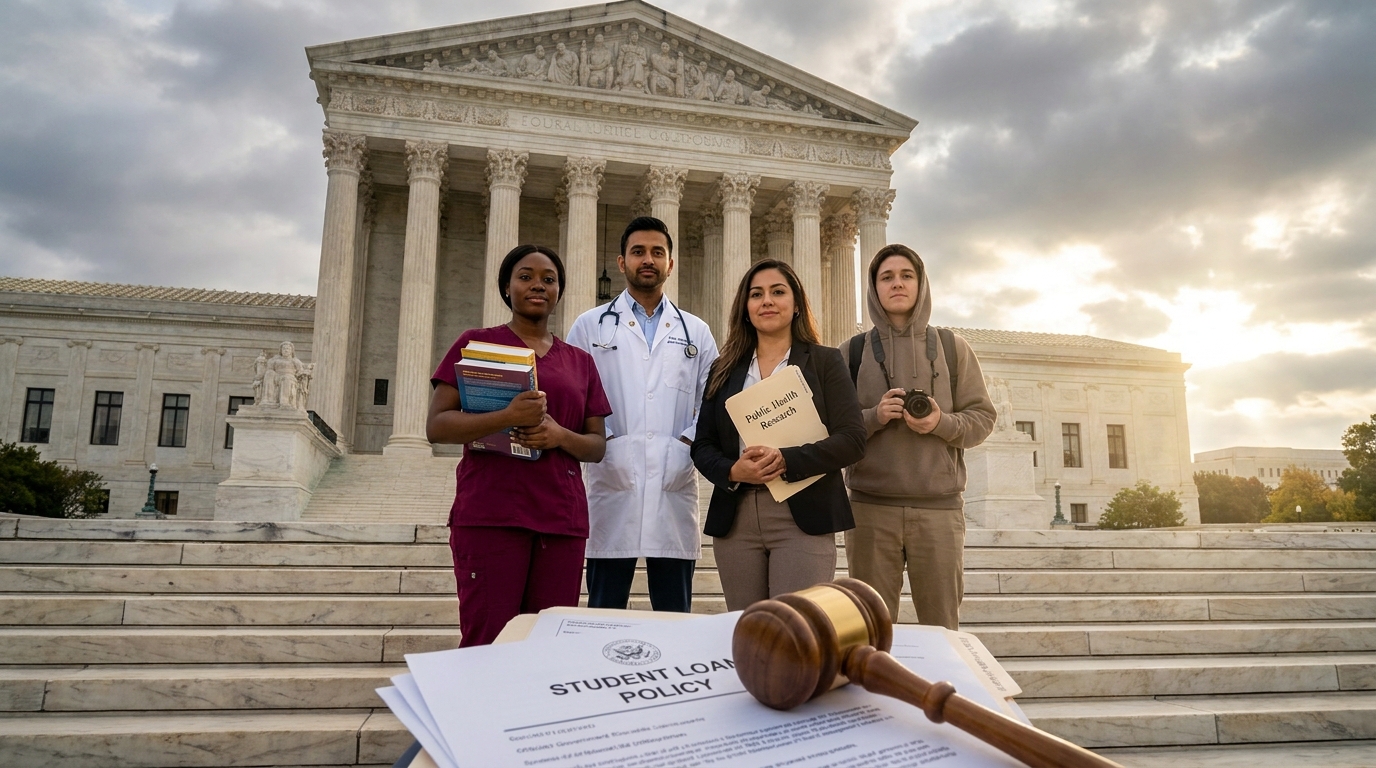
A federal judge blocked part of Trump’s new graduate student loan limits that would have slashed borrowing for nursing, public health, and education students. Here’s exactly what changed, what didn’t, and what grad students must do right now.
If you’re a nursing student, a physician assistant candidate, or pursuing a graduate degree in public health or education, you may have spent the last few months watching a financial deadline creep closer with growing dread. That deadline? July 1, 2026. That’s when sweeping new federal student loan caps, part of the Trump administration’s One Big Beautiful Bill Act, were set to go into effect.
But on June 25, 2026, something shifted. A federal judge stepped in — and for now, at least partially, hit the brakes.
Here’s what actually happened, what it means in plain English, and what every graduate student needs to know going into the next academic year.
The Law That Started It All: The One Big Beautiful Bill Act
To understand the ruling, you first have to understand the law behind the chaos.
In July 2025, the Republican-led Congress passed President Trump’s sweeping tax and spending package — formally called the One Big Beautiful Bill Act (OBBBA). Buried inside that legislation were massive changes to how Americans borrow money for graduate school.
Before the OBBBA, graduate students could borrow through the Grad PLUS loan program 2026, which let them borrow up to the full cost of attendance with no hard cap. That program, which millions of students relied on, has now been eliminated for new borrowers starting July 1, 2026.
In its place, the new law created two borrowing tiers:
- Professional degree programs (like medical school and law school): up to $50,000 per year, capped at $200,000 lifetime
- All other graduate programs: up to $20,500 per year, capped at $100,000 lifetime
That second number is where the problem exploded. Because the Education Department, when implementing the law, published a list of just 11 fields that qualify as “professional” — and therefore eligible for the higher $200,000 cap. That list includes medicine, dentistry, law, pharmacy, theology, and a handful of others.
What’s not on that list? Nursing. Physician assistant programs. Physical therapy. Occupational therapy. Public health. Marriage and family therapy. Education.
In other words, entire healthcare pipelines — fields the country desperately needs — got quietly classified as lower-tier graduate programs subject to the harsher $100,000 lifetime cap.
What the Judge Actually Blocked : Graduate Student Loan Limits
U.S. District Judge Beryl Howell in Washington, D.C. issued her order late on June 25, 2026, just six days before the July 1 effective date.
Crucially, Judge Howell did not block the new loan caps entirely. The overall annual and lifetime borrowing limits remain in effect. What she specifically froze was the Education Department’s definition of “professional degree” — the narrow 11-field list that left nursing, PA programs, and public health students locked out of the higher borrowing tier.
Eight trade organisations filed the challenge, including the American Association of Nurse Practitioners and the PA Education Association. They argued that the Education Department’s definition of a professional degree was “arbitrary and capricious” — meaning it drew an important policy distinction without adequate legal reasoning.
Judge Howell agreed, at least enough to issue a temporary block while the case plays out in court.
“We are pleased that those who rely on the Direct Loan Program to contribute to their communities by seeking degrees in nursing, public health, education, and marriage and family therapy will be able to do so,” said Skye Perryman, CEO of Democracy Forward, the legal group representing the plaintiffs.
The Education Department responded with a brief statement: they are “reviewing the order and will take appropriate action.”
Why This Fight Matters Beyond the Courtroom
The legal debate is about regulatory definitions, but the real-world stakes are about something much bigger: the future of the American healthcare workforce.
Consider what it actually costs to become a nurse practitioner or a certified registered nurse anaesthetist (CRNA). These are now three-year doctoral programs. Depending on the school, total program costs range from $60,000 to $200,000 — and that’s before living expenses, which add up quickly in programs that don’t allow students to work full-time.
Under the OBBBA as written, a student in a nurse anaesthesia program would be capped at $100,000 in total federal borrowing — potentially $100,000 short of what their degree actually costs. The gap doesn’t disappear. It just gets filled by private loans with higher interest rates, no income-driven repayment options, and no path to Public Service Loan Forgiveness.
The American Nurses Association called the original rule “profoundly dismaying,” noting that the country is already facing a historic nursing shortage. Rural and underserved communities, in particular, rely on advanced practice nurses as primary care providers.
The irony is stark: the policy meant to lower the cost of education could, in the short term, make entire healthcare careers financially inaccessible — especially for first-generation students, minority borrowers, and anyone without family wealth to fall back on.
What the Education Department and Supporters Say
There’s a coherent argument on the other side of this debate — and understanding it matters if you want the full picture.
Education Secretary Linda McMahon and supporters of the loan caps argue that the restrictions are designed to force colleges to lower their prices. The logic: if students can’t borrow unlimited amounts, schools can’t charge unlimited tuition.
And there’s some early evidence that this pressure is working. Purdue University and UC Irvine both reportedly cut tuition at their business schools by up to 40% to stay within federal loan cap limits. Johns Hopkins is offering Maryland graduates a 50% discount on master’s programs.
“It is our overall goal to bring down the cost of college and education,” Secretary McMahon said in a statement. “If we can bring down the cost for nurses in schools, we can get more students to apply.” That’s not an unreasonable long-term hope. But higher education experts point out that budget cycles and tuition-setting processes take years. Students making enrolment decisions today can’t wait for institutions to maybe lower prices sometime in the future.
The Bigger Legal Fight: 25 States Have Also Sued
The June 25 ruling isn’t an isolated event. It’s part of a broader legal battle that’s been building for months. Understanding the graduate student loan limits 2026 is crucial before you make any enrollment decision
Back in May 2026, a coalition of 25 states and the District of Columbia — including California, New York, Arizona, and North Carolina — filed their own federal lawsuit challenging the new loan limits. Their argument centres on the same basic problem: that nurses, physician assistants, and public health professionals are being unfairly excluded from the professional degree classification.
New York Attorney General Letitia James framed it bluntly: “This rule will shut talented people out of critical professions and leave communities with fewer health care providers they desperately need.”
Separately, U.S. Senators Jeff Merkley and Roger Wicker introduced a bipartisan bill that would classify post-baccalaureate nursing degrees as “professional degrees” outright — effectively solving the classification problem through legislation rather than litigation.
The fact that this fight has drawn bipartisan Senate attention and a 25-state coalition tells you something important: this isn’t a fringe concern. It’s a mainstream policy debate with massive workforce implications.
What Graduate Students Need to Do Right Now

Given all the legal uncertainty, what should grad students — especially those in nursing, healthcare, education, and counselling programs — actually do?
1. Check your loan disbursement date. The OBBBA’s changes apply to loans disbursed on or after July 1, 2026. If you received a federal Grad PLUS loan before that date, you may qualify for legacy protections and continue borrowing under the old rules for a limited period. Confirm this with your school’s financial aid office immediately.
2. Know your program’s classification. With the judge’s block in place, the “professional degree” definition is frozen — but the situation remains fluid. Ask your financial aid office how your program is currently classified and what that means for your federal borrowing limits.
3. Don’t assume the block is permanent. Judge Howell issued a temporary block pending further court proceedings. The situation could change. Plan with that uncertainty in mind.
4. Explore all funding options. Even in the best-case legal scenario, Grad PLUS loans are still eliminated for new borrowers. Look into teaching assistantships, research stipends, institutional scholarships, and any employer tuition assistance programs. If you must turn to private loans, compare rates carefully and understand that private loans don’t qualify for income-driven repayment or Public Service Loan Forgiveness.
5. Follow StudentAid.gov for official updates. Policy details are still being finalised. The official guidance from the U.S. Department of Education is the most reliable source for what actually applies to your loans.
Stay updated through StudentAid.gov for the latest policy changes.
The Bottom Line
A federal judge just handed nursing students, PA students, and public health students a partial but meaningful win — at least for now. The narrow definition of “professional degree” that would have locked them into harsher federal student loan borrowing limits has been temporarily frozen.
But the broader challenge remains. The Grad PLUS loan program is still gone. New annual and lifetime caps are still real. And the legal fight over who gets classified as a “professional” is far from over.
If you’re a graduate student — or planning to become one — the rules around federal student loan limits, graduate borrowing caps, and professional degree classification have never mattered more. The courtroom battle is ongoing, Congress is debating fixes, and schools are scrambling to respond.
Stay informed. Talk to your financial aid office. And don’t make any enrolment or borrowing decisions based on assumptions — the landscape is changing fast.
You Might Also Like