A real-world look at the Fidelity 500 Index Fund — how it works, what it costs, who it’s for, and whether it deserves a spot in your portfolio.
Fidelity 500 Index Fund: What I Wish Someone Had Told Me Before I Bought In
I remember staring at my Fidelity account for the first time, trying to decide where to put my next paycheck’s contribution, and landing on a fund with a ticker that looked like alphabet soup — FXAIX. No flashy marketing, no influencer hype, just a boring-looking mutual fund that quietly tracks the 500 biggest companies in America. Turns out that “boring” is exactly the point, and exactly why so many long-term investors keep coming back to the fidelity 500 index fund year after year.
If you’re trying to figure out whether this fund belongs in your 401(k), Roth IRA, or regular brokerage account, let’s walk through it the way I wish someone had walked me through it — no jargon dump, no sales pitch, just the straight story.
What Exactly Is the Fidelity 500 Index Fund?
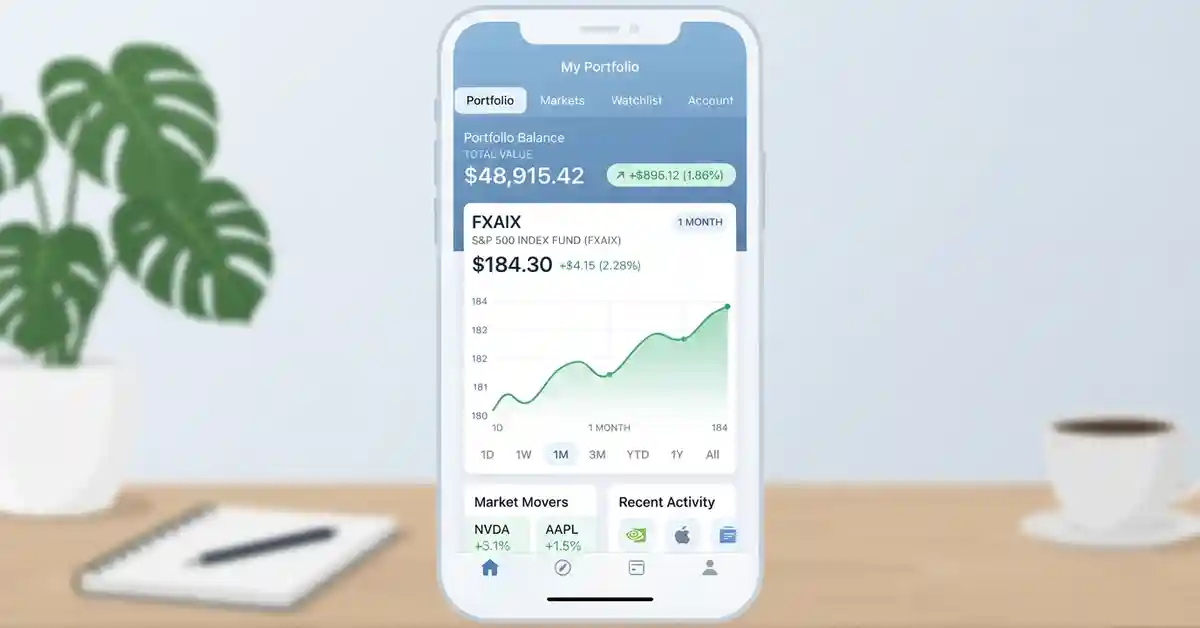
The fidelity 500 index fund, ticker symbol FXAIX, is a mutual fund launched by Fidelity Investments back in 2011. Its job is simple: mirror the S&P 500 Index as closely as possible. That means when you buy a share of FXAIX, you’re not betting on one company — you’re getting a small slice of roughly 500 of the largest publicly traded companies in the U.S., from the household names in tech to industrial giants and healthcare leaders.
There’s no fund manager trying to outsmart the market by picking winners. Instead, the fund simply holds what the index holds, in roughly the same proportions. This passive approach is exactly why it’s become a go-to core holding for so many retirement accounts.
How It’s Different From an ETF
One thing that trips people up: FXAIX is a mutual fund, not an ETF. That distinction matters more than it sounds like it should. Because it’s a mutual fund, <cite index=”7-1″>it trades only once a day at its net asset value after the market closes, rather than throughout the trading day like an ETF such as VOO or IVV would.</cite> You can’t set a limit order or watch the price bounce around in real time — you place your order, and it fills at whatever the closing price turns out to be.
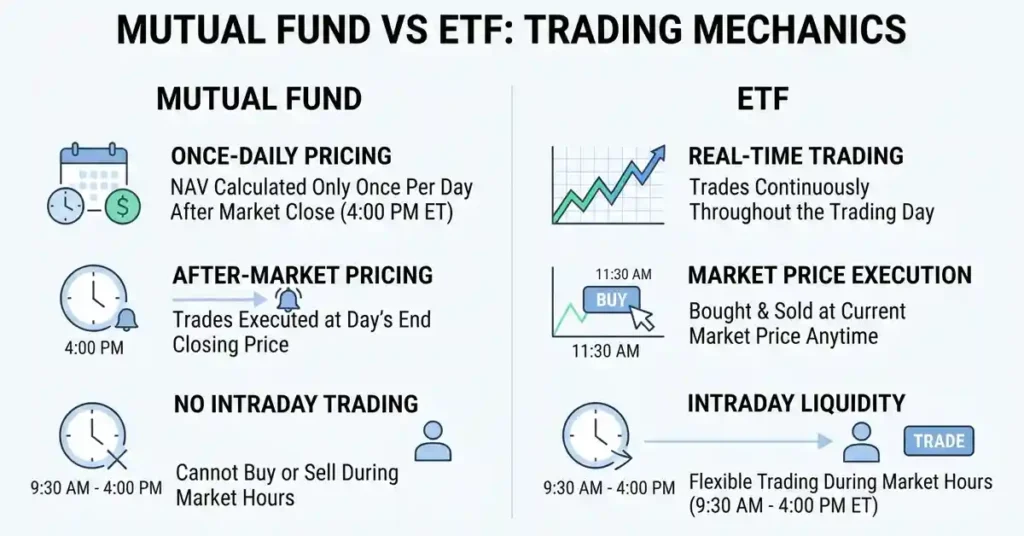
For a long-term investor who’s contributing regularly and not trying to time the market, this rarely matters in practice. But it’s worth knowing before you buy.
Why the Expense Ratio Keeps Coming Up in Every Conversation
If you’ve read anything about this fund, you’ve probably seen its expense ratio mentioned like it’s a badge of honor — and honestly, it kind of is. <cite index=”7-1″>The fund’s published expense ratio sits at around 0.015%, which is among the lowest in the entire fund industry, meaning almost every dollar of the index’s return flows straight through to you as the shareholder.</cite>
Put in plain terms: for every $10,000 you invest, you’re paying somewhere in the ballpark of a dollar and a half a year in fees. That’s not a typo. Compare that to actively managed mutual funds that can charge 1% or more annually, and you start to see why cost-conscious investors gravitate toward index funds like this one. Even against other cheap S&P 500 options, <cite index=”1-1″>FXAIX undercuts popular ETFs like VOO and IVV, which typically run around 0.03%.</cite>
Fees might feel small on paper, but they compound just like your returns do — in the opposite direction. Shaving off even a fraction of a percent every year, over decades, is money that stays invested and keeps growing instead of quietly leaking out to a fund company.
No Minimum Investment, No Excuses
Another detail that makes this fund approachable for beginners: there’s no minimum initial investment required, and Fidelity doesn’t charge a transaction fee to buy or sell it. You can start with whatever amount you’re comfortable with and build from there, which removes one of the biggest psychological barriers to just getting started.
What’s Actually Inside the Fund
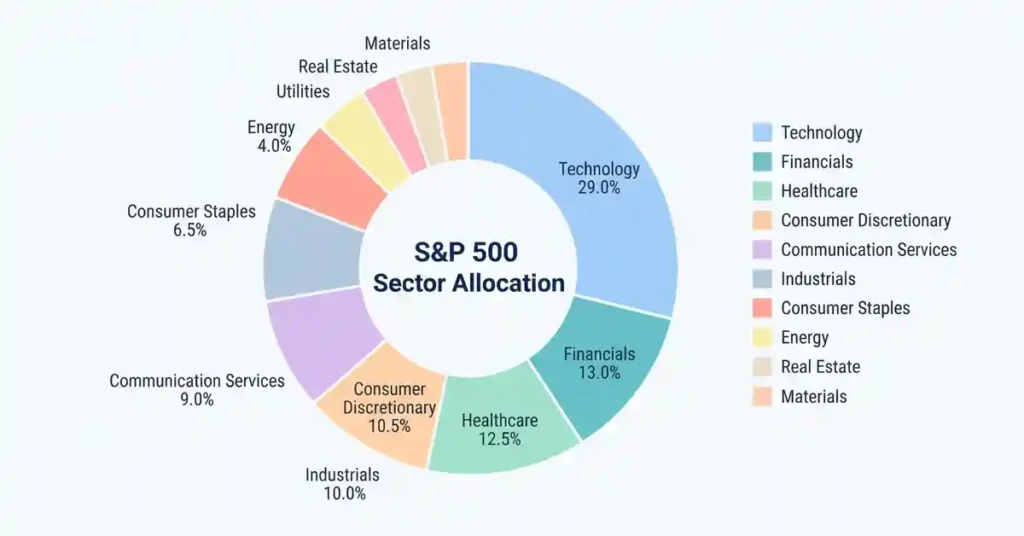
Since FXAIX tracks the S&P 500, its holdings shift naturally as the index itself is reconstituted. <cite index=”1-1″>The fund spans all eleven GICS sectors, though technology tends to carry the heaviest weight, typically landing somewhere in the high-twenties to low-thirties percentage range of total assets.</cite> That means your returns are meaningfully tied to how a handful of mega-cap tech companies perform, alongside contributions from healthcare, financials, consumer goods, energy, and the rest.
This concentration is a double-edged sword worth sitting with for a second. When large tech companies are thriving, the fund benefits disproportionately. When they stumble, so does your balance. It’s not a flaw exactly — it’s just a reflection of how the U.S. market itself is currently weighted, and something to keep in mind rather than something to be alarmed by.
Performance: What History Actually Shows
It’s tempting to lead with recent returns because, frankly, they’ve looked strong. But context matters more than the headline number. The S&P 500 has historically delivered somewhere around 10% annualized returns before inflation over many decades — and recent years have run noticeably hotter than that long-run average, largely on the back of a small group of dominant technology companies.
That’s worth remembering the next time a chart looks unstoppable. Strong trailing performance doesn’t guarantee what happens next, and the same concentration that’s boosted returns lately is the same force that could just as easily amplify losses in a rough stretch. During the 2022 downturn, for example, broad S&P 500 funds like this one fell by roughly a third from their peak before eventually recovering. That’s not a reason to avoid the fund — it’s a reason to go in with realistic expectations about volatility and a long enough time horizon to ride it out.
The One Real Downside: Portability
Here’s the part that doesn’t get mentioned often enough. Because FXAIX is a Fidelity-proprietary mutual fund, you can’t transfer it “in kind” to another brokerage like Schwab or Vanguard if you ever decide to switch platforms. You’d typically need to sell it first, which in a taxable account could trigger a capital gains tax bill you weren’t planning for.
For most people investing inside a 401(k) or IRA at Fidelity for the long haul, this is a non-issue. But if you value the flexibility of moving your investments freely between brokerages down the road, it’s worth having on your radar before you commit a large taxable-account position to this fund.
Who Is This Fund Actually Good For?
Based on everything above, the fidelity 500 index fund tends to make the most sense for:
- Long-term investors who want broad U.S. stock exposure without picking individual stocks
- People contributing regularly to a Fidelity 401(k), Roth IRA, or traditional IRA
- Anyone prioritizing low fees over trying to beat the market
- Beginners who want a simple, “set it and forget it” core holding
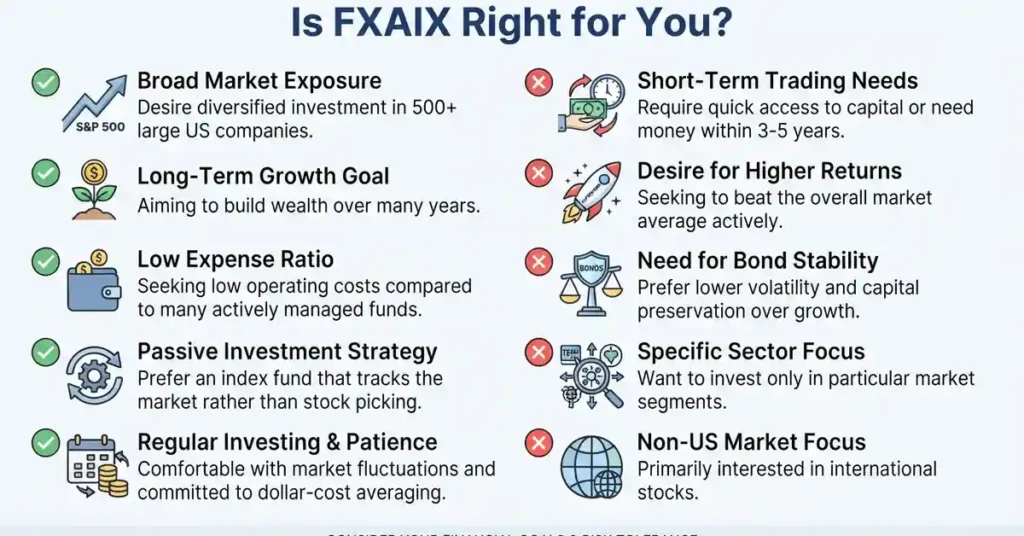
It’s probably less ideal for someone who wants intraday trading flexibility, plans to move brokerages soon, or is specifically trying to build a taxable account they’ll want maximum portability on — in those cases, an ETF equivalent might be a better fit.
The Fidelity 500 Index Fund (FXAIX) can be a good choice for investors who want a simple and low-cost way to grow their money over time. It is designed for people who prefer a passive investing approach and are comfortable holding their investments for the long term, usually five years or more. By investing in FXAIX, you get exposure to some of the largest and most established companies in the United States, which can help build steady wealth over time. This fund is also suitable for those who do not want to actively manage their portfolio and are okay with normal market ups and downs.
However, FXAIX may not be the right option for everyone. If you are looking for quick profits or short-term gains, this fund may not meet your expectations. It is also not ideal for investors who want to actively trade or try to outperform the market. Additionally, if you are uncomfortable with market volatility or need a consistent income for monthly expenses, you might want to consider other investment options.
A Quick, Honest Disclaimer
I’m not a licensed financial advisor, and nothing here should be taken as personalized investment advice. Fund performance, expense ratios, and minimums can change, so it’s always worth double-checking current numbers directly on Fidelity’s official fund page before making a decision. What works for one person’s retirement timeline and risk tolerance won’t necessarily work for someone else’s, so treat this as a starting point for your own research, not a final answer.
Frequently Asked Questions
Is the Fidelity 500 Index Fund good for beginners? Yes, generally. It has no minimum investment, low fees, and a simple, passive strategy — all of which make it approachable for someone just starting to invest.
What is the difference between FXAIX and FNILX? FNILX is Fidelity’s zero-expense-ratio fund that tracks a proprietary Fidelity index closely resembling the S&P 500, but it isn’t officially licensed as the S&P 500 itself. FXAIX tracks the actual S&P 500 Index and carries a very small fee to cover that licensing.
Can I buy the Fidelity 500 Index Fund outside of Fidelity? No. As a Fidelity mutual fund, it’s only available for purchase through a Fidelity brokerage account.
Does the Fidelity 500 Index Fund pay dividends? Yes, it distributes dividends passed through from the underlying companies in the S&P 500, which can be reinvested automatically or taken as cash.