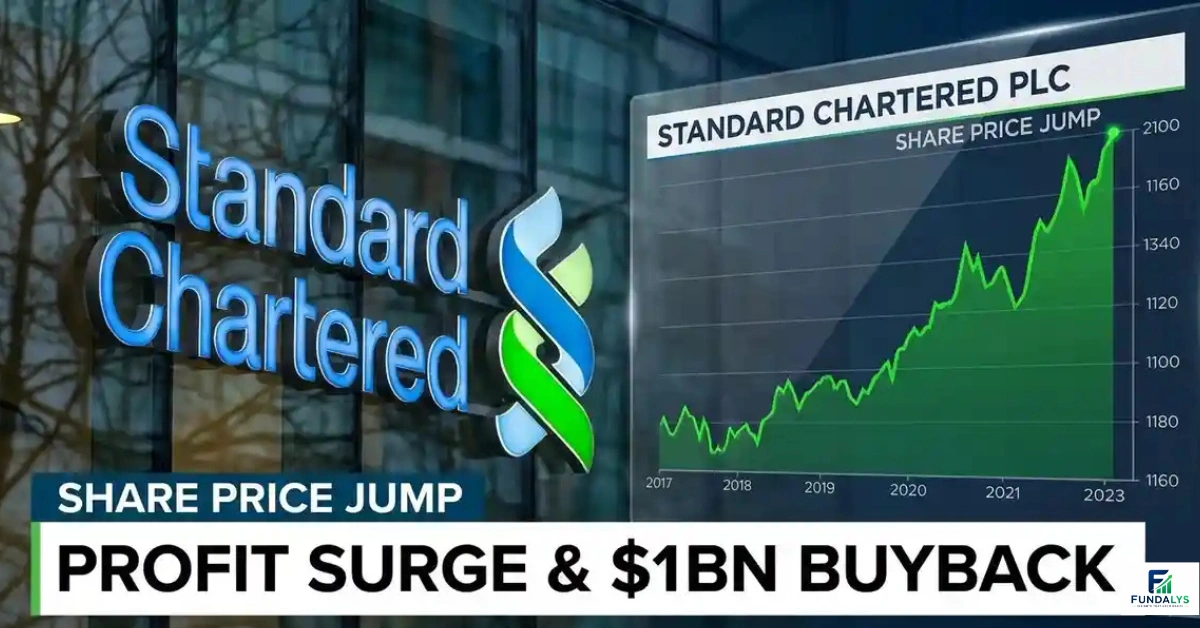
Standard Chartered stock rises after record H1 2026 profit beats forecasts. Bank unveils $1B buyback, raises dividend, and lifts full-year guidance I’ll admit, banking earnings usually don’t get me excited — but this one caught my attention for a good reason. Standard just posted numbers that beat almost every analyst estimate on the table, and instead of sitting on that extra cash, the bank turned around and announced a fresh $1 billion share buyback. That combination — a genuine beat plus a big capital return — is exactly the kind of headline that makes shares jump the way Standard’s did this week.
So let’s actually dig into what happened here, why the market reacted so strongly, and what’s really driving the growth underneath these numbers. No jargon-soup, just a clear walk-through of what this earnings report tells us.
The Numbers Behind the Beat
Let’s start with what the bank actually reported, because the details here matter more than the headline number.
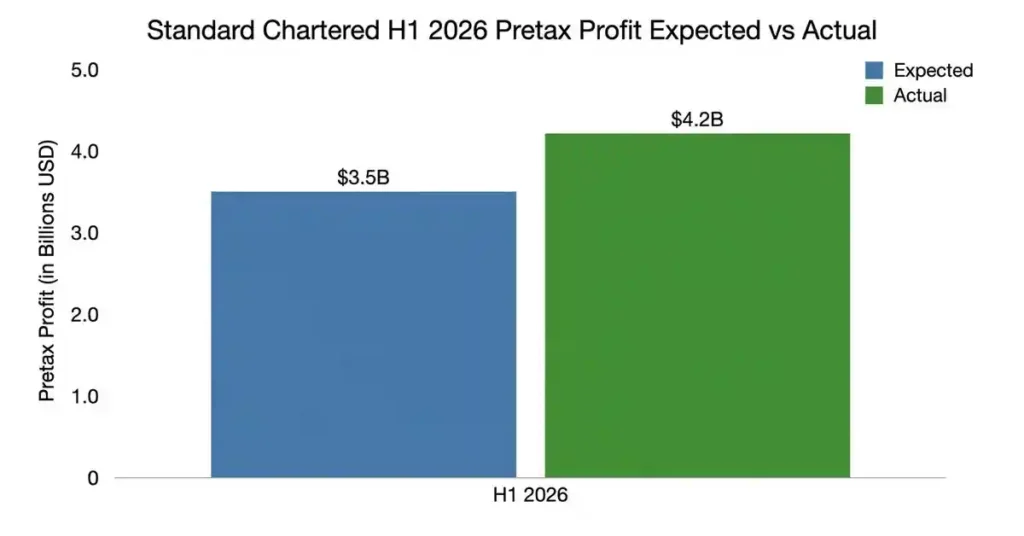
For the first half of 2026, pretax profit came in at $4.78 billion, up 9% from the year before — and comfortably ahead of the $4.52 billion analysts had expected. Net profit told an even stronger story, climbing 10% to a record $3.37 billion, beating estimates of around $3.01 billion.
Zooming into the second quarter alone, pretax profit hit $2.33 billion, which was roughly 13% ahead of consensus. Earnings per share came in at 77.4 cents, beating expectations by about 17%. That’s not a narrow squeak past estimates — that’s a genuine, clear beat across almost every line item.
Why This Beat Wasn’t Just Luck
What stood out to me digging into this is that the beat wasn’t driven by one lucky line item — it came from multiple directions at once. Operating income landed at $5.70 billion, about 3% ahead of forecasts, helped by both net interest income and a 5% beat on non-interest income. On top of that, costs actually came in 2% lower than expected, and credit impairments were 37% below what analysts had modeled. When revenue beats, costs undershoot, and credit losses come in lighter all in the same quarter, that’s a genuinely broad-based result, not a one-off surprise.
Wealth Management Is Doing the Heavy Lifting
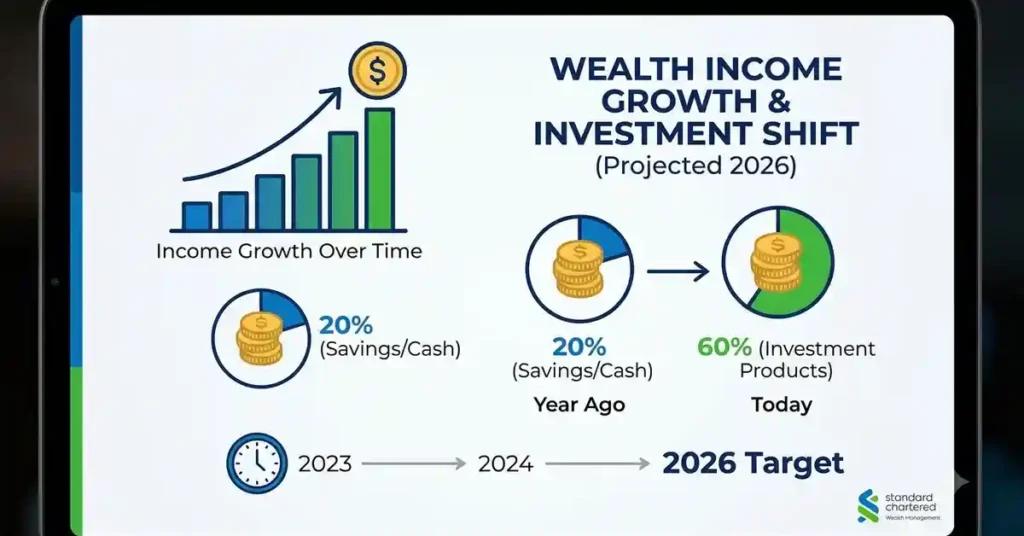
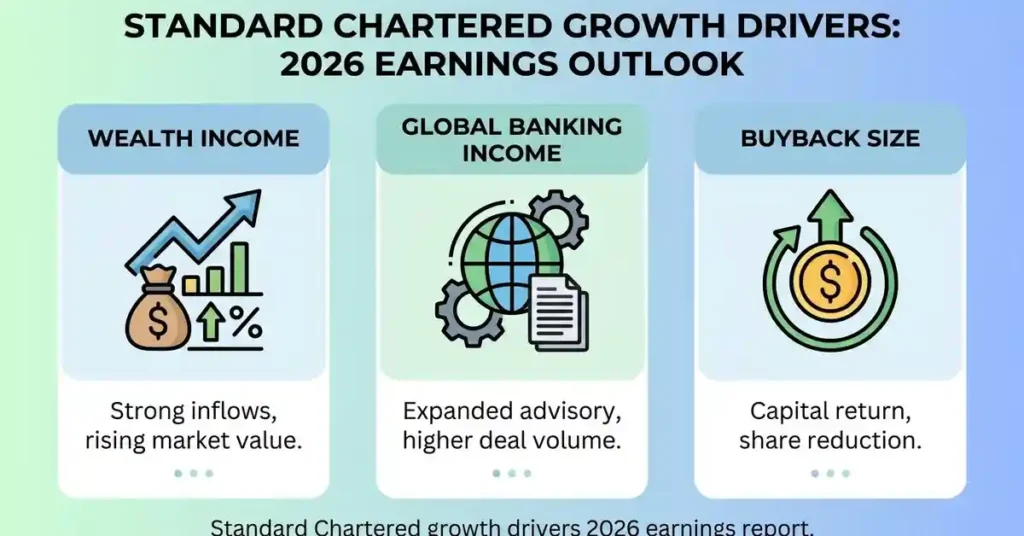
If there’s one theme running through this entire report, it’s wealth management. Income from the wealth business surged 38% year-over-year for the half, and in Q2 alone, wealth solutions delivered a record $1.1 billion in income, up 43% year-on-year.
What I find genuinely interesting here is where that growth is coming from. It’s not just people parking more cash in deposits — 60% of net new money went into investment products, compared to just 20% a year earlier. That’s a meaningful shift toward higher-fee, higher-margin business, which tends to be a much better quality of earnings than deposit-driven growth.
The bank also pulled in $15 billion of net new money in the quarter, with $9 billion of that coming specifically from wealth clients. And this growth happened despite Beijing tightening rules on cross-border investment accounts — a headwind that was expected to weigh on banks like Standard operating heavily in that region.
The $1 Billion Buyback Explained
Here’s the part that really got investors’ attention. Alongside the earnings beat, Standard announced a fresh $1 billion share buyback, on top of an interim dividend of 20.4 cents per share — up sharply from 12 cents a year earlier.
Buybacks like this send a fairly direct signal: management believes the bank has more capital than it currently needs for growth, and it’s confident enough in the business to return that surplus to shareholders rather than hoard it. The bank’s CET1 ratio — a key measure of capital strength for banks — stood at 14.2%, reflecting how much capital the bank generated through the quarter.
It’s also worth noting this isn’t the first buyback in this run. The bank had just completed its previous buyback programme in late June, having repurchased $1.5 billion worth of stock. Layering a new $1 billion programme right on top of that shows a pretty clear pattern of ongoing capital return, not a one-time gesture.
How the Market Reacted
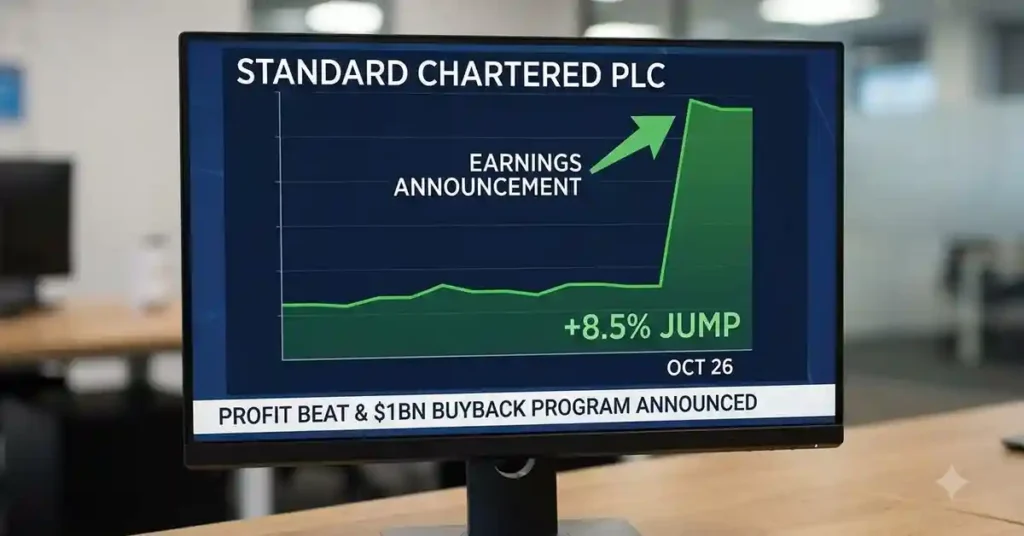
Shares jumped as much as 6-7% following the announcement, pushing the stock to levels not seen in almost 19 years in some trading sessions. That kind of reaction tells you the market wasn’t just pricing in the profit beat — it was rewarding the combination of strong underlying growth and a credible signal that management is confident enough to keep returning cash to shareholders.
What’s Weighing on the Other Side
It wouldn’t be a fair picture without mentioning the headwinds, because there are a few worth knowing about.
The bank booked additional impairment charges tied to the ongoing conflict in the Middle East, on top of $190 million in “precautionary management overlays” set aside the previous quarter related to tensions involving Iran. The Middle East represents around 6% of Standard’s total exposure, with the bulk of that concentrated in the UAE, followed by Saudi Arabia.
This is a reminder that Standard’s business model — deeply rooted in Asia, Africa, and the Middle East — comes with geopolitical exposure that a purely domestic bank simply wouldn’t have. It’s part of why the bank’s growth story is exciting, but it’s also why there’s a layer of risk that’s worth watching in future quarters.
What This Means Going Forward
Management didn’t just report strong numbers — they also raised guidance. Standard now expects full-year 2026 income growth to land around the middle of its 5% to 7% target range, an upgrade from previous guidance that pointed toward the lower end of that range.
CEO Bill Winters described this as a “record first-half performance,” pointing to double-digit growth in both wealth solutions and global banking as key drivers. Global banking income itself rose 19% year-over-year, benefiting from more dealmaking activity and stronger investor engagement across markets.
Taken together, this earnings report tells a story of a bank whose core growth engines — wealth management and global banking — are firing at the same time that cost discipline is holding up and credit losses are staying contained. That’s a fairly rare combination in banking results, which is likely why the stock reaction was as strong as it was.
Frequently Asked Questions
Why did Standard Chartered’s profit beat expectations? The beat was broad-based — operating income came in above forecasts, costs were lower than expected, and credit impairments were well below what analysts had modeled, all in the same quarter.
How big is Standard Chartered’s new share buyback? The bank announced a fresh $1 billion share buyback, on top of raising its interim dividend to 20.4 cents per share.
What is driving Standard Chartered’s growth right now? Wealth management income surged sharply, driven by a shift toward higher-fee investment products, alongside strong growth in global banking from increased dealmaking activity.
Is Standard Chartered facing any risks? Yes — the bank has booked impairment charges tied to the Middle East conflict, given its exposure to markets like the UAE and Saudi Arabia, which is a factor worth watching in coming quarters.
Did Standard Chartered raise its full-year guidance? Yes, the bank upgraded its 2026 income growth guidance to the middle of its 5% to 7% target range, up from Guidance closer to the bottom of that range previously.
You may also like
- Best 0% APR Credit Cards in the USA (2026): 24 & 36-Month Interest-Free Offers Compared
- How to Build Credit From Scratch in 2026 (Step-by-Step Guide)
- Is 700 a Good Credit Score? Everything You Need to Know in 2026
- Is a Credit Card Annual Fee Worth It in 2026? credit card annual fee worth it | credit card debt 1 trillion
- Best Credit Cards 2026: Rewards & Cash Back | Fundalys
- Federal Judge Blocks New Graduate Student Loan Limits 2026
- How This Couple Paid Off $40K Debt in 18 Months (No Extreme Budgeting!)